Survey inspections are one of the most important tools for checking quality, safety and compliance with standards in many industries, from shipping to construction and oil and gas. But what exactly does the term "survey" mean? Who are surveyors and what do they do? In this article we explain in detail what a survey involves, what types of inspection there are and why they are key to minimising risks and keeping many logistics and industrial processes reliable. If you need a surveyor now, you can order a survey on the service page, which sets out the types of inspection, lead times and the request form.
Submit an applicationA survey is an independent expert inspection of the condition of cargo, a vessel, a vehicle or equipment at various stages of the transport and storage of goods. Its main purpose is to establish whether the cargo conforms to the declared terms, record any damage, assess risks and prevent losses.
A surveyor is a specialist who carries out survey inspections and gives an expert assessment of the condition of the cargo and the conditions of carriage. The surveyor is an independent party working in the client's interests, providing detailed reports and the necessary documents.
A survey inspection is a tool for checking the quality and quantity of cargo and the condition of the means of transport. It is needed to:
Record the condition of the cargo and the vessel before, during or after carriage.
Prevent disputes between parties in the logistics chain by acting as an independent party and providing reliable information on the quality and quantity of the cargo.
Protect the client's interests and reduce financial risks.
Establish the causes of any damage, losses, breaches of packaging or cargo integrity, or incorrect documentation of the cargo.
In some cases the procedure is mandatory, and it can be decisive in litigation, insurance matters or customs clearance.
No two surveys are exactly alike, since everything depends on the cargo and the mode of transport. Even so, a surveyor's work can be broken down into the following main stages:
Preparation. Reviewing the request, signing the contract, obtaining the accompanying documents and defining the inspection objectives.
Inspection. Attending the inspection site; visual and technical inspection of the cargo, the means of transport and/or the equipment.
Photo and video documentation. Photographing the packaging, marking, seals, cargo condition, stowage and securing.
Measurements and weighing. Where necessary, checking the quantity and weight of the units carried.
Reporting. A detailed survey report with findings, photos, a description of the work done and recommendations for rectifying any irregularities found.

Surveys come in many forms. These are the main types used in logistics, manufacturing and international trade:
Inspection of the cargo: packaging, marking, condition, quantity and conformity with the documents.
Assessment of the vessel's condition before or after a voyage: any damage, technical systems, fuel and documents.
Supervision of loading and unloading: compliance with the required conditions, cargo integrity, equipment operation, correct securing.
Carried out when damage or losses occur. It helps to establish the causes and assess the loss.
Inspection of containers before stuffing or after transport, including checks for watertightness and compliance with requirements.
Monitoring of storage conditions in the warehouse, including temperature, mould, insects and other risks.
Preparation of accompanying documents and checks for compliance with international requirements.
A survey can be ordered by any party with an interest in transparent cargo transport and protection against risk:
Exporters and importers: to record the condition of the cargo before and after carriage.
Logistics companies: to confirm the quality of their services.
Insurance companies: for an independent assessment of damage and calculation of compensation.
Banks: in documentary transactions and when entering into pledge and leasing agreements.
Suppliers and buyers: to reduce the risk of claims and of receiving substandard goods that do not match the declared characteristics.
When choosing a survey company, consider:
licences and certifications;
experience and client reviews;
the qualifications and reputation of its specialists;
how promptly and fully it provides information;
its ability to provide inspection coverage in different regions, along the entire route of the cargo.
A survey is best planned for the following stages:
Before dispatch: the quality and quantity of the cargo and the condition of the vehicle/container are recorded, and stowage, marking and sealing are checked.
During transit: to monitor the transport conditions.
After arrival: to record any damage, loss or shortage and to supervise unloading.
Ideally, a survey should be booked a few days before the planned inspection, especially if the site is in a remote location.
Yes, but it is a risk. Without an independent report it will be much harder to:
Prove the damage to your insurer;
Confirm that there were no violations during customs clearance;
Protect your interests in court in a dispute with a carrier or supplier.
A survey is not only about peace of mind: it is also a way to protect your business from losses and unforeseen situations.
Unfortunately, yes. As in any other field, there are unscrupulous contractors, corruption and other problems. At TopFrame this is unacceptable. Independence is the core principle of our work. A surveyor must not be affiliated with the seller, the buyer or the carrier. We monitor this strictly and immediately end cooperation with any contractor who breaks the rules of fair and transparent inspection.
From a few hours to a day, depending on the location and the complexity of the job. We recommend booking a cargo inspection in advance, but if an emergency arises, we will do everything we can to find the nearest available surveyor and send them to the inspection site.
To request a surveyor, use the TopFrame survey services page; a manager will reply during business hours.
Although the core principle of surveying is always independent inspection and objective fact-finding, a surveyor's daily responsibilities depend heavily on their specialization:
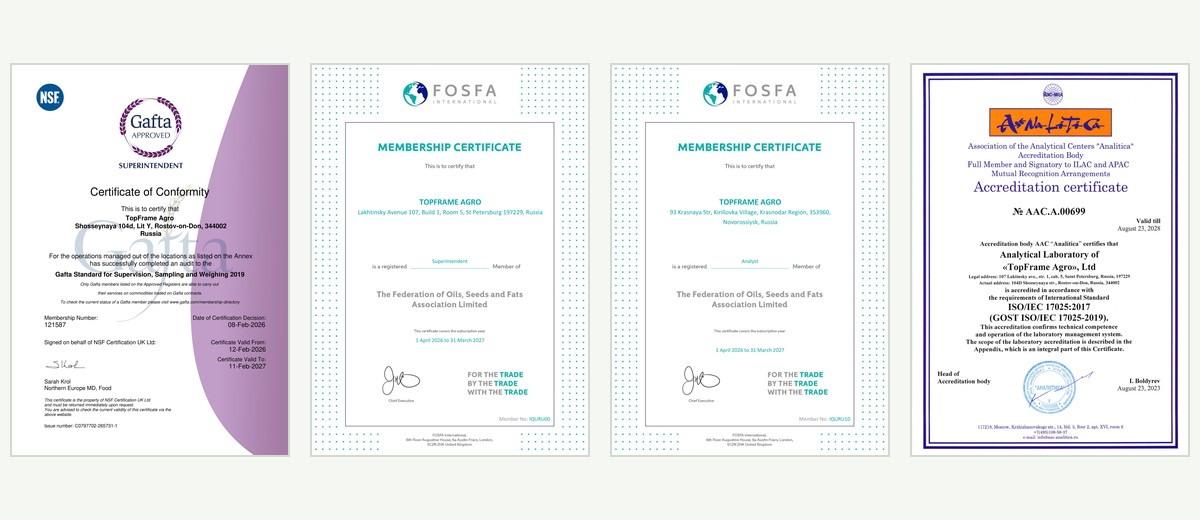
TopFrame (with over 400 inspectors and commodity experts operating across Russia and 20+ countries) offers practical online training programs on the MTS Link platform for both newcomers and practicing specialists, including our Fresh Fruit & Vegetable Quality Inspection Course and our specialized grain surveyor training developed by TopFrame Agro (GAFTA Approved Superintendent No. 121587, FOSFA Member No. IQURU00 & No. IQURU10, ISO/IEC 17025 accredited laboratory No. AAC.A.00699).